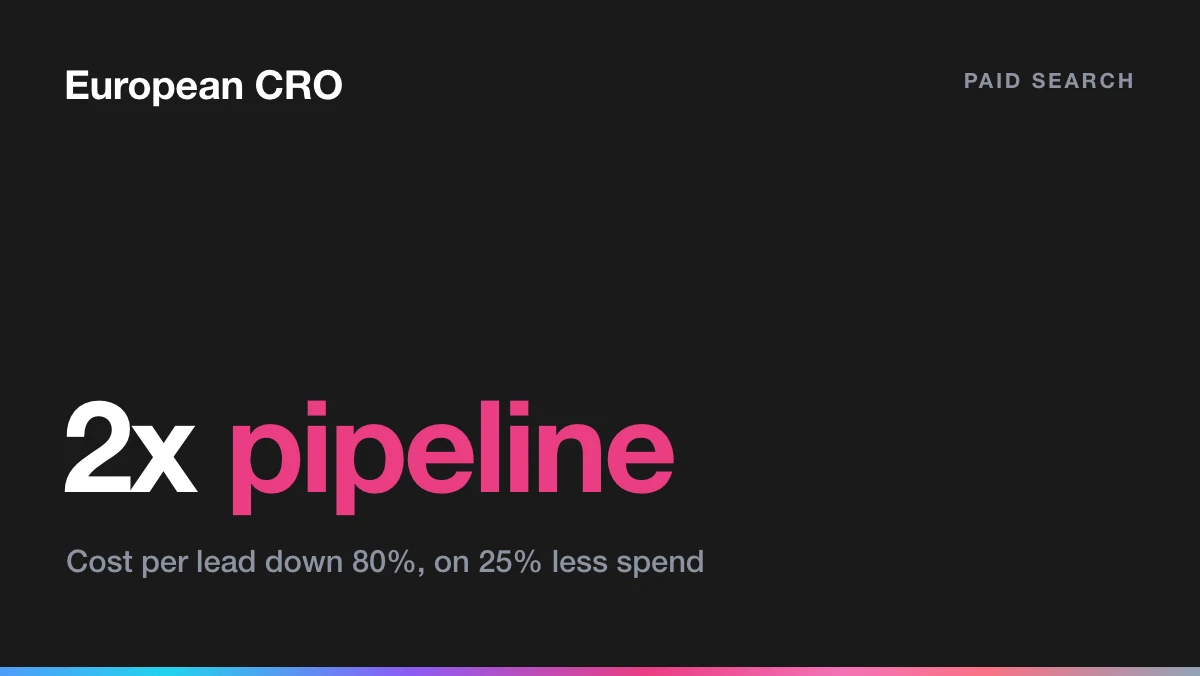
European CRO
Owning the Funnel: How a European CRO Doubled Pipeline on 25% Less Spend
80% lower
Cost per lead
~2x
Sales pipeline
PPCMarketing Ops
Services Used
Instem is a software solution provider for the life sciences industry, supporting clinical and preclinical customers with analysis software and services that drive discovery, accelerate studies, and advance research. After a period of high inorganic growth and multiple acquisitions, Instem needed to integrate three CRM systems into one Salesforce Enterprise instance, with a completion deadline of January 1, 2026.
Marzipan was brought in to lead the complete integration: auditing data across all three systems, harmonizing field structures, migrating all records, and training the acquired commercial teams to operate within Instem's platform from day one of the new year.
After a period of high inorganic growth and multiple acquisitions, Instem was operating across three separate CRM environments, supporting three distinct commercial teams (Preclinical, d-wise, and Autoscribe) with centralized marketing, business operations, finance, and people and culture functions sitting alongside. Each CRM had its own account structures, processes, and naming conventions, requiring the simultaneous migration of three distinct systems into a single Salesforce instance.
“The acquisition of Xybion and other recent acquisitions were far larger than previous ones. With that came full integration requirements across the whole company, finance, product, operations, sales, and the CRM and customer data side of things. This was a much bigger piece of work across multiple CRM platforms that we needed expertise and resources from external providers to get done.”
Leanne Coles
Business Operations Manager, InstemThe complexity wasn't just technical. Each acquired business had different data hygiene standards, field naming conventions, and compliance requirements for what was captured and how it was captured.
Three distinct CRM systems, each with different field structures, object types, and data standards, needed to be mapped into a single Salesforce instance. Each acquired business used different naming conventions, account hierarchies, and contact ownership models that varied greatly from the Instem customer data structure.
“The complexities of the mapping, and getting the data aligned into a way that's useful for our sales team and our business, that was the difficulty. We didn't want to flood our instance of Salesforce with data that was going to compromise any of the outputs or measures that we needed to make as a business afterwards.”
Leanne Coles
Business Operations Manager, InstemInstem considered several options, including internal resources, before selecting Marzipan to lead the integration. With a firm December deadline and a highly complex project, the decision was based on technical expertise, timeline alignment, and a less tangible sense of confidence.
“When having conversations with different suppliers, there's a feeling you get, a feeling of care and a feeling of getting a job done. It's a combination of both of those things that came across with Marzipan. You were evidently capable, but you also cared and were invested in the business and the outcome. I didn't see that failure was going to be an option.”
Leanne Coles
Business Operations Manager, InstemLeanne identified trust as the key factor that set Marzipan apart from other options. This trust was evident in the project's approach from the outset, rather than being based on price or methodology.
“The overarching element for the decision-making is definitely trust. Definitely trust.”
Leanne Coles
Business Operations Manager, InstemWith only eight weeks to complete the project, precision was critical. Marzipan began with a discovery phase, collaborating with key stakeholders in each acquired organization to identify business-critical elements, legacy data, and requirements for the new Salesforce environment.
All records across the three CRM systems were evaluated using a clear framework: migrate, archive, or discard. Proprietary custom fields were cataloged. Where possible, fields and processes were transitioned to Instem's standard tools; otherwise, new fields and objects were created in Salesforce to maintain operational continuity.
Accounts, contacts, opportunities, quotes, historical emails, contracts, and file attachments were all included to ensure that sales representatives could access all relevant information in Salesforce from the start of the new year.
The primary risk in such projects is not technical failure, but lack of user adoption. Acquired teams often resist new systems. Marzipan addressed this by involving legacy sales teams and their managers from the outset, rather than introducing a completed migration at the end.
“We involved the legacy sales teams and their managers within the integration project, because we needed their help and support to identify what their data points were, why they kept them, what they were measuring, and to be able to fully translate that not only into Salesforce, but to create the training materials and training sessions to help the team through that change process.”
Leanne Coles
Business Operations Manager, InstemBy the time formal training began, teams had already contributed to the migration and helped shape the new system. This approach led to a sense of familiarity and smoother adoption.
“Like with any major organizational change, there was anxiety that the project could impact or interrupt the team's day-to-day support for our customers, but everyone has fully adopted the changes without issues and are all integrated into one CRM.”
Leanne Coles
Business Operations Manager, InstemThe December 31 deadline was firm. All acquired commercial teams needed to be operational in Salesforce before the new year. The final phase, documentation migration, was completed in early January without disrupting sales, as teams maintained access to legacy systems during the transition.
Instem began January 2026 with a unified system. All accounts, contacts, opportunities, quotes, emails, and documents were in place. Pipeline visibility was consolidated, enabling sales managers across all three commercial teams to work from a single platform and forecast. Success in a project of this nature can be subtle, as Leanne described:
“We're done, we're on time, we're on budget, we're happy. The measure of success in this is that the users don't feel it. The users don't feel the change, and that's what makes a project like this successful.”
Leanne Coles
Business Operations Manager, Instem
A successful CRM consolidation starts with a data audit, not a migration. You need to understand what each system holds, which records are business-critical versus archivable, and how field structures need to be harmonized before anything moves. Instem's three-system consolidation began with stakeholder interviews inside each acquired business, mapping proprietary processes, custom fields, and data ownership, before a single record was imported into Salesforce.
Instem's project, covering three CRMs and a full migration of accounts, contacts, opportunities, quotes, documents, and email history, was completed in eight weeks, with a hard go-live deadline of December 31, 2025. The key variable is having a dedicated resource committed to the project, not team members absorbing it alongside existing workloads.
People, not data. Acquired teams working in familiar systems are resistant to change, especially when that change is presented to them rather than built with them. Instem's integration involved directly involving legacy sales teams and managers in the data audit and field mapping process. By the time formal training arrived, the teams already understood the new system.
Yes, but it requires careful planning of access windows, a phased migration, and a bridge period during which teams retain legacy system access while migration completes. Instem's acquired teams had full access to their historical systems throughout the transition. Zero downtime was a design requirement, not a hope.
Yes. Marzipan leads end-to-end Salesforce CRM consolidation projects for life sciences organizations, including data auditing, field mapping, record migration, custom object creation, revenue operations setup, and acquired team training. Explore Marzipan's marketing operations services or view all case studies.