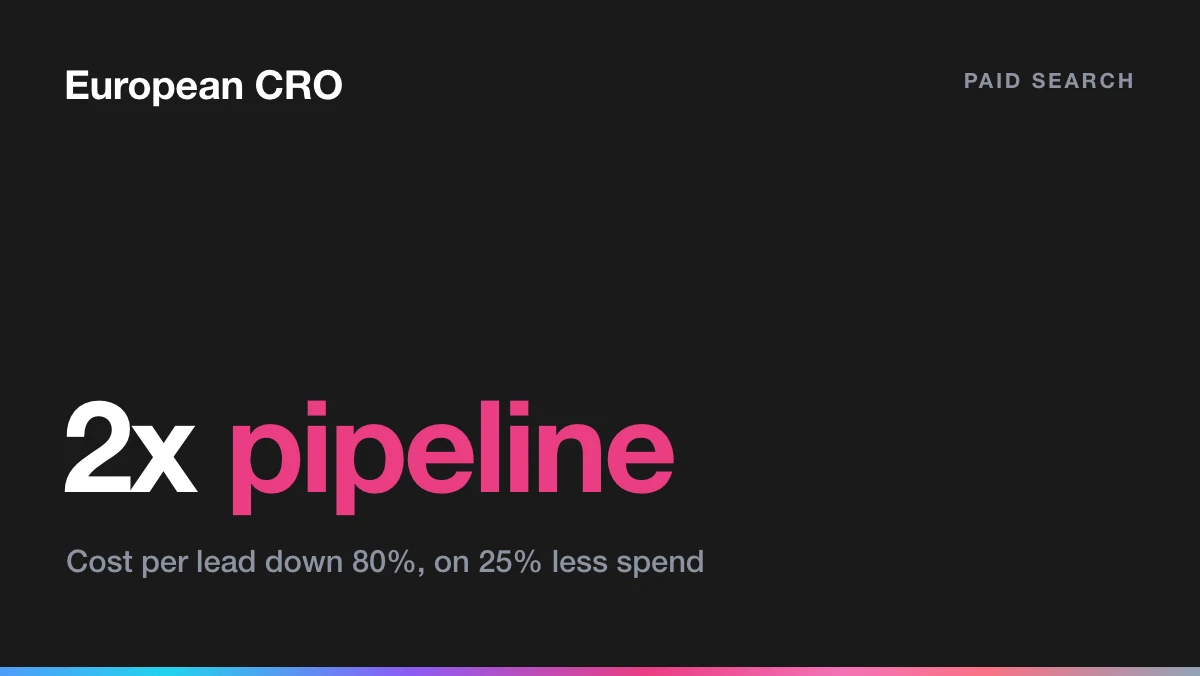
European CRO
Owning the Funnel: How a European CRO Doubled Pipeline on 25% Less Spend
80% lower
Cost per lead
~2x
Sales pipeline
PPCMarketing Ops
Services Used
Clarke Energy is a global leader in the engineering, design, installation, and long-term maintenance of distributed energy solutions. Operating in 27 countries with over 1,500 employees, the company supports industries including utilities, manufacturing, data centers, and renewable energy. Clarke Energy has delivered more than 10GW of power generation capacity worldwide, including 1.5GW fueled by renewable biogas.
After investing in Salesforce for Sales and Operations use, the Clarke Energy marketing team needed to stand up their chosen marketing automation platform (Pardot), and implement downstream processes that allowed the marketing team to report on and attribute marketing efforts to lead generation, campaign performance, and pipeline.
Marzipan was engaged to deliver the full implementation in a fixed six-week statement of work: field architecture, email templates, automations, form handler integration, lead management, flows and process design, attribution reporting, and team training with written documentation. By the end of week six, everything was operational and Clarke Energy could manage everything independently.

Before the implementation, Clarke Energy's marketing team managed performance separately from their CRM. General inquiries from the website reached Salesforce, but without a purpose-built lead management process, lead assignment, lead outcomes, and campaign attribution were not easy to determine. Leads from other sources such as tradeshow attendance were not being synced, giving the team no visibility to pipeline contribution and ROI from different marketing campaigns and efforts. Email marketing was proving difficult in Pardot, and email templates needed fresh configuration, using new branding, to allow the team to quickly and consistently build messages of distinct formats for newsletters, event invitations, and promotions.
Building a complete Pardot implementation from scratch is as much a sequencing exercise as a technical one. Every decision has downstream consequences. For example, field creation must precede automation setup, object layouts depend on the fields and layouts and permission sets that already exist, campaign dashboards need filterable fields and genuine campaign members to report on, and form handlers need Pardot fields to write into before they can process a submission.
The practical challenge was moving the fields, requirements, and processes that the marketing department needed into Salesforce, and having it complement what was already established for Sales and Service users, without adding unnecessary bloat to their production environment. We were building a future state that all stakeholders could understand, agree to, and maintain without feeling like a disruption to how they had always worked.
Clarke Energy evaluated several recommended Salesforce partners and CRM integration agencies before selecting Marzipan. The deciding factor was not Salesforce or Pardot expertise in isolation. It was the combination of that expertise alongside complementary digital marketing and web development experience.
Marzipan was already managing Clarke Energy's website and search and answer engine optimization, and had fundamental knowledge of systems and processes that Clarke Energy relied on in their current state. This allowed us to tie in the back-end requirements of CRM and marketing automation platform (MAP) to the front-end experience their visitors would have on web pages and in search and AI tools. It also meant Clarke Energy's team could continue to work with single points of contact and avoid communication breakdowns between two independent vendors working on siloed parts of the whole digital infrastructure.
In short: we were able to easily configure data capture and tracking on the website with the fields, forms, consent management, and UTM data necessary for marketing processes to succeed in both Pardot and Salesforce.
Marzipan began with a full review of Clarke Energy's existing marketing technology environment, data requirements, and commercial processes. The implementation was sequenced across five workstreams, each one a prerequisite for the next.
Before Pardot can function as a B2B marketing platform, the Salesforce data model needs to be structured for marketing use. Marzipan built the complete field architecture across Lead, Contact, Campaign, and Campaign Member objects. Every marketing data point Clarke Energy needed was mapped to its Pardot equivalent and placed in the correct section of the relevant object layout.
Country-State configuration was applied to ensure web form data captured on the Clarke Energy website mapped correctly through Pardot into Salesforce, preventing silent validation failures that would otherwise quietly drop records or break automation rules downstream.
Four branded production-ready email templates were designed and built within Pardot: an advisory template, a newsletter, a webinar and event invitation, and a master template with various layout options and styles. All templates were mobile optimized and configured for a simple select, edit, send marketing email workflow.
An email preference center was built to allow recipients to manage their own subscriptions. Custom fields were created to help the team track consent status and dates of last consent, and global include and exclude lists were created to help the team quickly prepare compliant audiences for Pardot email sends.

Global form handlers were created for each form submission type (Inquiry, Webinar, Resource, Newsletter) to allow for global completion actions, while also giving the team flexibility to determine custom actions based on which page the form was submitted on.
Two Salesforce Flows were built to automate processes that would otherwise require manual intervention or produce unreliable attribution data. CAMPAIGN MEMBER: Set Attribution Values (UTM) stamps UTM source data onto the Campaign Member record at the point of campaign response, then nulls the values from the source record to preserve attribution accuracy across future engagements. LEAD/CONTACT: Set Timestamps on Key Events captures Responded Date, Status Change Date, and Lead Assignment Date, enabling the commercial team to measure lead velocity and sales responsiveness.
WordPress form handlers were integrated end-to-end with Pardot so the inbound flow from website inquiry to Salesforce record was reliable and consistent.
Lead and Contact statuses were configured to reflect each stage of the commercial journey, with closed reason tracking and assignment rules that route inbound leads to the correct sales owner based on country, industry, and product application.
Three Salesforce dashboards were built to give the marketing and commercial teams full visibility from day one: a Campaign Management Dashboard, an Opportunity Influence and Attribution Dashboard, and a Housekeeping and Data Hygiene Dashboard. Each dashboard was scoped to a specific user group with its own questions to answer, rather than a single catch-all report that no one would use.

Every process configured during the project was documented before handover. The Salesforce for Marketing manual was structured in chapters covering each key object and process, paired with live training sessions on email build, list import, form processing, automation, lead routing, reporting, content management, and sales team actions.
By the time formal training ran, the team had already been involved in the field mapping decisions. They arrived at each session already familiar with the system's logic, not encountering it for the first time.
At the end of week six, every capability described in the five workstreams was operational. Email templates were ready to use. Subscription management was live. Form handlers were pulling web inquiries automatically into Salesforce and routing them to the right owner. Automations were running. Dashboards began to show relevant information, and historical data was showing historical marketing influence on pipeline. The team had documentation to operate everything independently.
“As relatively new users of Pardot, our department faced a steep learning curve and were spending a significant amount of time troubleshooting issues, which was challenging given the complexity of the platform. The Marzipan team did a fantastic job getting us up to speed and brought all their expertise and experience from other Pardot-Salesforce configurations and applied it in our environment, giving us everything we needed to run marketing through Salesforce in just six weeks.”
Graeme Stanley
Group Communications Manager, Clarke Energy
Heading into 2026, the team are well placed to demonstrate the impact of marketing efforts and make better decisions with campaign and channel attribution.
A complete Pardot implementation covering audit, field architecture, email template build, subscription management, campaign configuration, lead management, attribution reporting, form handler setup, data automations, and team training can be delivered in six weeks with dedicated resource and clearly defined scope. Clarke Energy's implementation covered all ten workstreams within that window. Timeline depends on scope complexity and the client's ability to make configuration decisions. The single biggest variable is having one clear internal decision-maker, not a committee.
A full implementation covers: email template design and build; subscription management, preference center, and unsubscribe logic; field creation across Salesforce Lead, Contact, Campaign, and Campaign Member objects with Pardot sync; Salesforce object layout design; campaign management, attribution, and housekeeping dashboards; Salesforce Flows for campaign membership automation, UTM attribution tracking, and timestamp fields; CMS setup, user roles, and folder structure in Pardot; website form handler integration; lead assignment rules; lead management with status and closed-reason configuration; and team training with written documentation.
Yes. Clarke Energy's implementation ran in parallel with their Salesforce onboarding as part of joining the Rehlko group's commercial technology environment. Running both platforms simultaneously requires experienced project management and a team that understands both systems end-to-end. It is achievable within a six-week window when scope is clearly defined at the outset and the client has a single point of accountability for decisions on their side.
Yes. The six-week implementation establishes a fully operational foundation. Ongoing support, including campaign execution, lead scoring and grading development, Engagement Studio nurture program build, attribution analysis, and platform optimization, is available as a retainer service. The value of ongoing support becomes clearest in the first months of live campaigns: dashboards start showing what is working, the scoring model needs tuning, and nurture programs can be built on top of the initial automation setup.
Treating it as an email platform rather than a revenue operations platform. Pardot works best when the Salesforce data model has been designed for marketing use, campaign attribution is configured from the start, and the lead management process is defined before any contacts enter the system. Building these foundations retrospectively is significantly harder than building them first. A good implementation partner will build the email capability. A great one will build the field architecture, the attribution model, the lead management process, and the reporting infrastructure, and train the team to use all of it. The email is the output. The platform is the infrastructure. marketing operations services or view all case studies.
They are the same product. Salesforce rebranded Pardot as Marketing Cloud Account Engagement (MCAE) in 2022. The core functionality is unchanged: it is Salesforce's B2B marketing automation platform, designed for lead generation, lead nurturing, email marketing, campaign management, and marketing attribution in complex B2B sales environments with long sales cycles. Both names remain in common use. Clarke Energy's implementation covers the full MCAE feature set.