
The biotechnology industry is booming. Global biotech revenues continue to climb, fueled by breakthroughs in gene therapy, mRNA platforms, precision medicine, and synthetic biology. Hundreds of new companies enter the space every year, each competing for the attention of investors, partners, healthcare professionals, and enterprise buyers.
But scientific innovation alone is not enough to win. The companies that grow fastest are the ones that pair strong science with strong marketing. And biotech marketing is not the same as marketing in other industries. The audiences are more technical, the sales cycles are longer, the regulatory environment is more complex, and the stakes are higher. A misstep in messaging costs you more than a click. It costs you credibility with an audience that values precision above all else.
This guide breaks down what makes biotech marketing different, the strategies that actually work, and how to build a marketing engine that drives real business results. If you are new to marketing in biotech or looking to sharpen your approach, this is a good place to start. For a broader view of marketing across the life sciences sector, see our complete guide to life science marketing.
What Makes Biotech Marketing Different
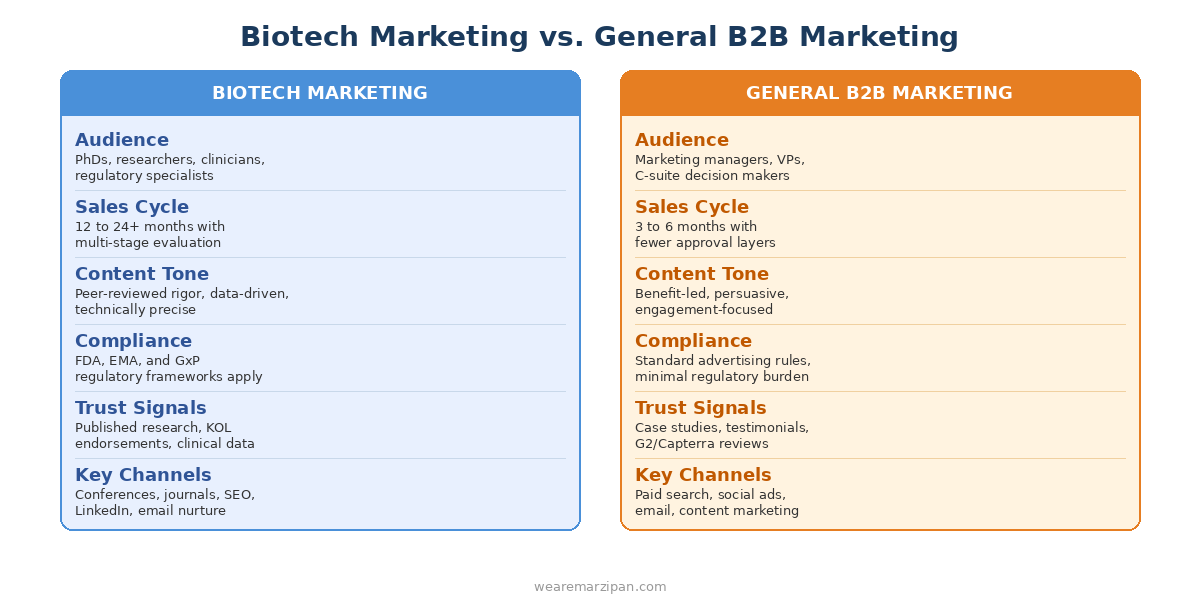
If you have ever tried to apply a standard B2B marketing playbook to a biotech company, you already know it does not translate cleanly. The differences are not superficial. They are structural, and they affect every part of your strategy, from the language you use to the channels you invest in.
Your Audience Thinks Like Scientists
Because they are scientists. Biotech buyers include researchers, lab directors, clinical operations leads, regulatory affairs specialists, and C-suite executives with deep scientific backgrounds. They do not respond to marketing jargon or vague benefit statements. They want data, evidence, and specificity. A claim like "our platform accelerates drug discovery" means nothing without supporting data. A claim like "our platform reduced lead identification timelines by 40% across three Phase I programs" earns attention.
Sales Cycles Are Measured in Years, Not Weeks
Enterprise biotech deals routinely take 12 to 24 months to close. The evaluation process involves multiple stakeholders, technical validation, pilot studies, procurement review, and often regulatory sign-off. Marketing cannot stop at generating a lead and handing it off. It needs to support the entire journey with the right content at the right stage, keeping your company top of mind through a long and often nonlinear decision process.
Regulatory Compliance Shapes Everything
Depending on your product area, your marketing may need to comply with FDA regulations, EMA guidelines, GxP standards, and institutional review board (IRB) requirements. This is more than a legal concern. It directly affects the claims you can make, the imagery you can use, and the speed at which content can be published. Biotechnology marketing teams that treat compliance as a built-in part of their workflow, rather than a bottleneck, move faster and produce better work.
Credibility Is Your Most Valuable Asset
In most B2B industries, a polished website and a few testimonials can establish baseline trust. In biotech, the bar is much higher. Your audience expects published research, peer-reviewed data, endorsements from key opinion leaders (KOLs), and demonstrated expertise in the specific therapeutic area or technology platform you serve. Building this credibility takes time, but it compounds. Once established, it becomes a moat that competitors struggle to cross.
The Biotech Marketing Playbook
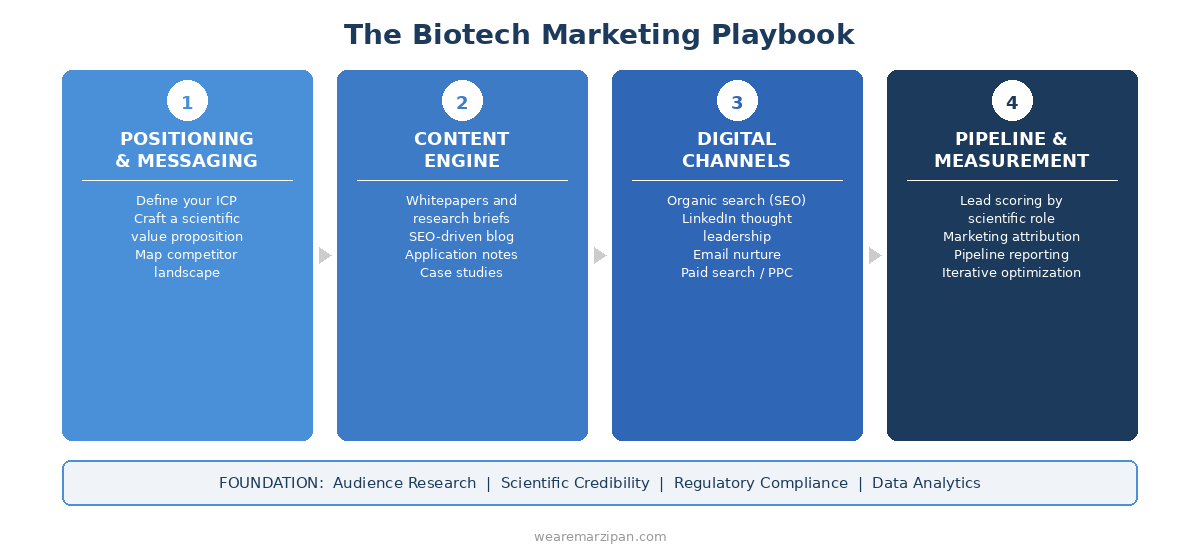
Knowing that biotech is different is one thing. Knowing what to actually do about it is another. Here is a four-part framework for building a biotech marketing strategy that works.
Pillar 1: Positioning and Messaging
Before you create a single piece of content or run a single ad, you need to get your positioning right. In biotech, this starts with a clear understanding of your ideal customer profile (ICP). Who exactly are you selling to? What therapeutic areas or technology platforms do they work in? What problems keep them up at night?
From there, you can craft a value proposition that resonates. The best biotech value propositions are specific, evidence-based, and differentiated. They answer the question: "Why should a scientist or biotech executive choose us over every other option, including doing nothing?"
Competitive mapping is also essential. Understand how your competitors position themselves, what language they use, and where they are strong or weak. This gives you the information you need to carve out a distinct space in the market.
Pillar 2: Build a Content Engine
Biotech content marketing is the single most effective way to build trust, attract qualified traffic, and nurture prospects through a long sales cycle. But it has to be done right. Generic "top 10" blog posts will not cut it in an industry where your readers have doctoral degrees.
The content types that perform best in biotech include:
- Whitepapers and research briefs. Deep dives into specific topics that demonstrate genuine expertise. These are ideal for gated lead generation and for establishing credibility with technical audiences.
- SEO-driven blog posts. Targeted articles that answer the specific questions your audience is searching for. In biotech, these tend to be highly technical and niche, which is actually an advantage since the competition for long-tail keywords is low.
- Application notes and technical guides. Practical, hands-on content that shows how your product or service works in real-world settings. Scientists love this format because it mirrors the way they consume information in journals and product literature.
- Case studies. Detailed accounts of how a customer used your product to solve a specific problem, complete with data and outcomes. In biotech, the more specific the better. Name the therapeutic area, the technology, and the results wherever possible.
- Video content. Product demos, expert interviews, and short explainer videos are increasingly effective, especially on LinkedIn and at conferences.
The key is consistency. Publishing one excellent piece per month will outperform publishing ten mediocre pieces. Build a content calendar, align it with your keyword strategy, and stick to it.
Pillar 3: Choose the Right Digital Channels
Not every marketing channel is equally effective in biotech. Here is where to focus your biotech digital marketing efforts.
Search engine optimization (SEO). Biotech SEO is one of the highest-ROI investments you can make. Researchers, procurement teams, and executives actively search for solutions online. Search competition in biotech is lower than in consumer or SaaS markets, meaning well-optimized content can rank relatively quickly. Focus on long-tail, high-intent keywords that match the specific language your audience uses.
LinkedIn. This is the primary social platform for biotech marketing. It is where your buyers spend their time, where industry conversations happen, and where thought leadership content gets the most traction. Focus on a mix of company page updates, personal posts from leadership, and targeted advertising.
Email nurture. With sales cycles that stretch over a year or more, email is essential for staying in front of prospects without being intrusive. Segment your lists by role, interest area, and buying stage, then deliver genuinely useful content on a consistent automated cadence.
Industry conferences and events. Events like BIO International Convention, AACR, JPM Healthcare Conference, and CPHI remain critical for relationship building and brand visibility. But the real value comes from integrating events into your broader marketing strategy.
Paid search. Google Ads targeting high-intent keywords can capture demand at the moment of need. The cost per click in biotech tends to be higher than average, but so does the deal value. For companies selling enterprise solutions with six- or seven-figure price tags, even a small number of conversions from paid search campaigns can deliver strong ROI. For the full paid-media playbook, see our guide to biotech advertising. If your campaigns are underperforming, our guide to common Google Ads issues is a good starting point for diagnosis.
Pillar 4: Pipeline and Measurement
Marketing in biotech is ultimately about building pipeline. Every campaign, piece of content, and channel investment should be tied back to business outcomes. The KPIs that matter most include:
- Marketing qualified leads (MQLs) generated by content, events, and digital campaigns
- Pipeline influenced by marketing: the dollar value of deals where marketing touchpoints played a role
- Organic search traffic and keyword rankings, particularly for high-intent terms
- Content engagement: whitepaper downloads, webinar registrations, email click-through rates
- Customer acquisition cost (CAC) and the ratio of CAC to customer lifetime value
Attribution is particularly challenging in biotech because of the long, multi-touch buying journey. A prospect might discover you through a Google search, download a whitepaper three months later, attend your conference booth, and request a demo six months after that. Multi-touch attribution models help you understand which channels are actually driving results so you can allocate budget more effectively.
Biotech Branding: Building Trust in a Skeptical Market
Biotech branding is not about logos and color palettes, although those matter. It is about building a reputation as a credible, trustworthy, and capable partner in a market where buyers are inherently skeptical. Scientists are trained to question claims and look for evidence. Your brand needs to hold up under that scrutiny. Our biotech branding services are built around exactly that test.
Strong biotech brands share a few common traits. They lead with science, not marketing speak. They are transparent about their capabilities and limitations. They invest in thought leadership, publishing original perspectives and data that demonstrate genuine expertise. And they are consistent, showing up with the same quality and tone across every touchpoint, from their website to their conference booth to their LinkedIn posts.
One of the most effective branding strategies in biotech is to invest in the personal brands of your scientific leaders. When your CSO publishes an article in a respected journal, when your VP of R&D speaks at an industry conference, when your team contributes to an open-source research initiative - these activities build brand equity in ways that no amount of advertising can replicate.
Common Biotech Marketing Mistakes to Avoid
Having worked with life science and biotech companies, we see the same mistakes come up repeatedly. Avoiding them will save you time, money, and credibility.
- Marketing like a tech company. Biotech buyers are not impressed by the same tactics that work in SaaS. Growth hacks, aggressive retargeting, and pushy sales sequences can actively damage your brand with a scientific audience.
- Neglecting SEO. Many biotech companies still rely almost entirely on conferences and word of mouth. While those channels are valuable, they are not scalable. A strong SEO and content foundation generates leads around the clock.
- Creating content for yourselves instead of your audience. Your website should not read like an internal brochure. Every page should answer the question: "What does the reader need to know, and why should they care?"
- Ignoring digital until you are ready to scale. The best time to build your digital presence is before you desperately need leads. SEO takes months to compound. Brand recognition takes even longer. Start early.
- Treating compliance as a blocker. Regulatory review does not have to slow you down if you build it into your workflow from the start. The best biotech marketing agency partners will already have this built into their process.
How does your brand perform in AI search?
Run a free AEO audit to see how visible your brand is in ChatGPT, Perplexity, and Google AI Overviews.
When to Work with a Biotech Marketing Agency
Many biotech companies, especially startups and scale-ups, do not have the resources to build a full in-house marketing team from day one. Hiring a head of marketing, a content writer, a designer, an SEO specialist, and a demand generation manager is expensive and time-consuming. A specialized biotech marketing agency can fill that gap, providing a ready-made team with deep industry knowledge.
The right agency partner will bring several advantages: scientific literacy (they can hold an informed conversation about CRISPR or monoclonal antibodies), experience navigating regulatory compliance, a portfolio of work in the biotech space, and the ability to scale up or down as your needs change.
When evaluating potential agency partners, look for evidence that they understand your specific niche within biotech. An agency that has worked with diagnostics companies may not be the best fit for a cell therapy startup. Ask for relevant case studies, talk to their references, and assess whether their team can speak credibly about your science. For a deeper look at what to consider when choosing an agency, our life science marketing guide covers the key evaluation criteria in detail.
Not getting this from your current agency?
See how Marzipan runs your whole funnel with senior specialists, tied to pipeline and revenue, for one flat monthly fee.
Getting Started with Biotech Marketing
If you are just getting started with marketing at a biotech company, or if you are rethinking an approach that has not been delivering results, here is a practical starting point:
- Define your ICP with precision. Go beyond broad categories like "biotech companies." Define the specific roles, therapeutic areas, company stages, and problems you are targeting.
- Audit your current presence. Review your website, LinkedIn, existing content, and search visibility. Where are the gaps? What is working?
- Build a keyword map. Identify the terms your audience is searching for and create a plan to produce content that targets those terms. Prioritize low-competition, high-intent keywords first.
- Create three foundational content pieces. Start with a pillar page that covers your core topic in depth, then support it with two more focused articles that link back to it.
- Activate LinkedIn. Get your leadership team posting regularly. Share original insights, comment on industry news, and engage with your target audience.
- Measure and iterate. Set up proper analytics from day one. Track keyword rankings, organic traffic, content engagement, and lead generation. Review monthly and adjust your strategy based on what the data tells you.
What It Comes Down To
Biotech marketing is not about following a standard B2B playbook with a scientific veneer on top. It requires a fundamentally different approach, one built on scientific credibility, technical depth, regulatory awareness, and a deep understanding of how your audience thinks and buys.
The good news is that most biotech companies are still underinvesting in marketing. The bar is not as high as you might think. A well-executed content strategy, a strong SEO foundation, and a consistent presence on LinkedIn can set you apart from the vast majority of your competitors. And because biotech audiences are so specific, you do not need massive traffic volumes to generate meaningful pipeline. You just need to reach the right people with the right message at the right time.
Start with the fundamentals, be consistent, and let the work compound. The companies that commit to this now will be the ones winning market share for years to come.
Marzipan is a marketing agency built for life science and biotech companies. If you need a partner who understands your science and knows how to turn it into pipeline, let's talk.

Written by
Joe Chamberlain
Head of Digital Marketing
Joe has over a decade of experience delivering high-impact digital strategies for B2B and B2C brands. He's built more than 200 websites and led countless SEO and performance marketing initiatives - each one focused on driving measurable ROI and sustainable growth.
More articles by Joe