
Life science marketing is one of the most challenging and rewarding disciplines in B2B. You're selling complex products and services to highly educated buyers - scientists, clinicians, procurement teams, and C-suite executives who can spot surface-level marketing from a mile away. Understanding the difference between technical and economical buyers is the starting point for effective messaging. Generic tactics don't work here. The messaging needs to be precise, credible, and rooted in genuine understanding of the science.
And yet, the companies that get life science marketing right see outsized results. They build trusted brands in niche markets, generate consistent inbound pipeline, and position themselves as the go-to partner in their space. Whether you're a biotech startup preparing for your first product launch, a pharma company looking to modernize your digital presence, or a medtech firm trying to stand out at your next conference - this guide covers what you need to know.
This is a complete guide to life science marketing in 2026. We'll walk through what makes this space unique, the strategies that actually work, the channels worth investing in, and how to build a content engine that drives real business growth. Let's get into it.
What Is Life Science Marketing?
Life science marketing covers all the strategies, channels, and tactics used to promote products, services, and brands within the life sciences industry. That includes pharmaceuticals, biotechnology, medical devices, diagnostics, clinical research organizations (CROs), lab equipment manufacturers, and more. For the outsourcing side of the industry, our guide to CRO and CDMO marketing covers how contract organizations win sponsor programs.
What separates life sciences marketing from standard B2B marketing comes down to a few factors:
- Highly technical audiences. Your buyers hold PhDs and MDs. They want substance, not slogans.
- Regulatory constraints. Pharma and medical device marketing must comply with FDA, EMA, and other regulatory frameworks. Claims need to be substantiated.
- Long sales cycles. Enterprise deals in life sciences can take 6-18 months. Marketing needs to nurture relationships across that entire timeline.
- Multiple decision-makers. A single purchase might involve scientists, procurement, quality assurance, and executive leadership - each with different concerns.
- Credibility is everything. Peer-reviewed data, case studies, and demonstrated expertise carry far more weight than flashy creative.
The sheer breadth of the life sciences sector matters too. A marketing strategy for a pre-revenue biotech startup will look very different from one designed for a global pharma company with thousands of products on the market. Similarly, a CRO marketing to clinical operations directors has different needs than a lab equipment manufacturer selling to academic researchers. The principles are consistent, but the execution must be tailored.
Understanding these dynamics is the starting point. Every strategy, channel, and piece of content you produce should be built on this foundation.
Why Life Science Marketing Requires a Specialized Approach
Many life science companies make the mistake of hiring a generalist marketing agency or following standard B2B playbooks. While the fundamentals of marketing still apply - audience research, positioning, content, distribution - the execution needs to be adapted for an industry where trust and expertise are the currency. Strong life science branding is where that adaptation starts.
The Language Barrier
Scientists don't respond to typical marketing language. Buzzwords like "disruptive," "cutting-edge," or "revolutionary" can actively undermine your credibility. Your content needs to speak the language of your audience - precise, evidence-based, and technically accurate. That doesn't mean it has to be dry, but it does mean your marketing team (or agency) needs to genuinely understand the science behind what you're selling.
Compliance and Regulatory Considerations
If you're in pharma or medical devices, everything your marketing team produces may need to go through a medical-legal-regulatory (MLR) review process. This affects timelines, creative freedom, and the types of claims you can make. A life science marketing agency that understands these constraints will build them into their workflow from the start - rather than treating compliance as an afterthought that delays everything.
The Importance of Thought Leadership
In life sciences, thought leadership isn't just a nice-to-have - it's a competitive advantage. Your audience attends conferences, reads journals, and follows key opinion leaders (KOLs). Companies that position themselves alongside these trusted voices earn attention and, eventually, business. This is especially true in biotech marketing and pharma marketing, where scientific credibility directly influences purchasing decisions.
The Life Science Marketing Funnel
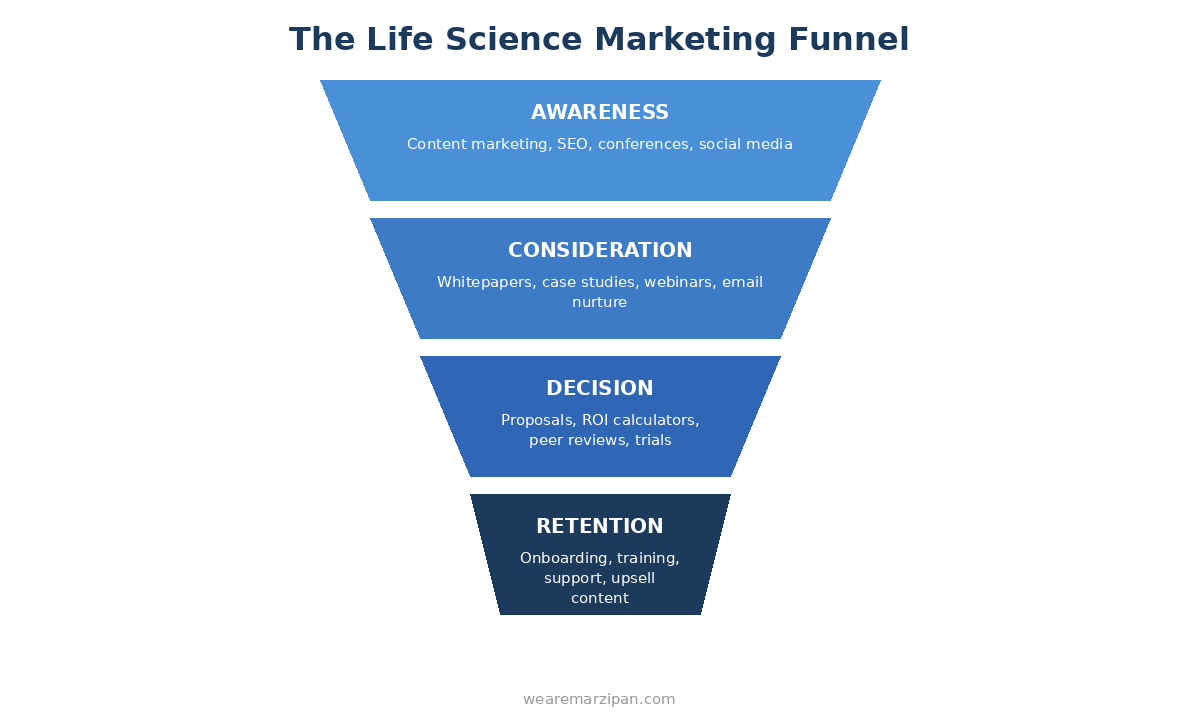
The traditional marketing funnel applies in life sciences, but each stage looks different when your buyers are scientists and clinicians. Here's how to think about it:
Awareness
At the top of the funnel, your goal is visibility. Life science buyers discover new vendors and solutions through industry conferences, peer recommendations, published research, and increasingly through organic search. This is where SEO, content marketing, PR, and social media (primarily LinkedIn) do their work. The content at this stage should educate, not sell. Think blog posts, trend reports, infographics, and educational webinars. All of it points back to your website, which is why life science website design is the foundation the rest of the funnel sits on.
Consideration
Once a prospect is aware of you, they'll start evaluating whether your solution fits their needs. This stage is all about depth. Whitepapers, detailed case studies, product comparison guides, and expert webinars help prospects assess your credibility and capability. Email nurture sequences are particularly effective here - dripping relevant, value-driven content over weeks and months.
Decision
At the decision stage, prospects are comparing you to 2-3 alternatives. They want proof: ROI calculators, reference calls, peer reviews, and detailed proposals. Your marketing should make it easy for sales teams to close by providing these assets in a polished, accessible format. In pharma and medtech, this stage often involves procurement and compliance teams, so having clear documentation of certifications, quality standards, and regulatory compliance is essential.
Retention
Marketing doesn't stop after the deal closes. Customer retention in life sciences depends on ongoing education, training content, product updates, and community building. Happy customers become your best marketing channel through referrals and case study participation.
Key Marketing Channels for Life Science Companies
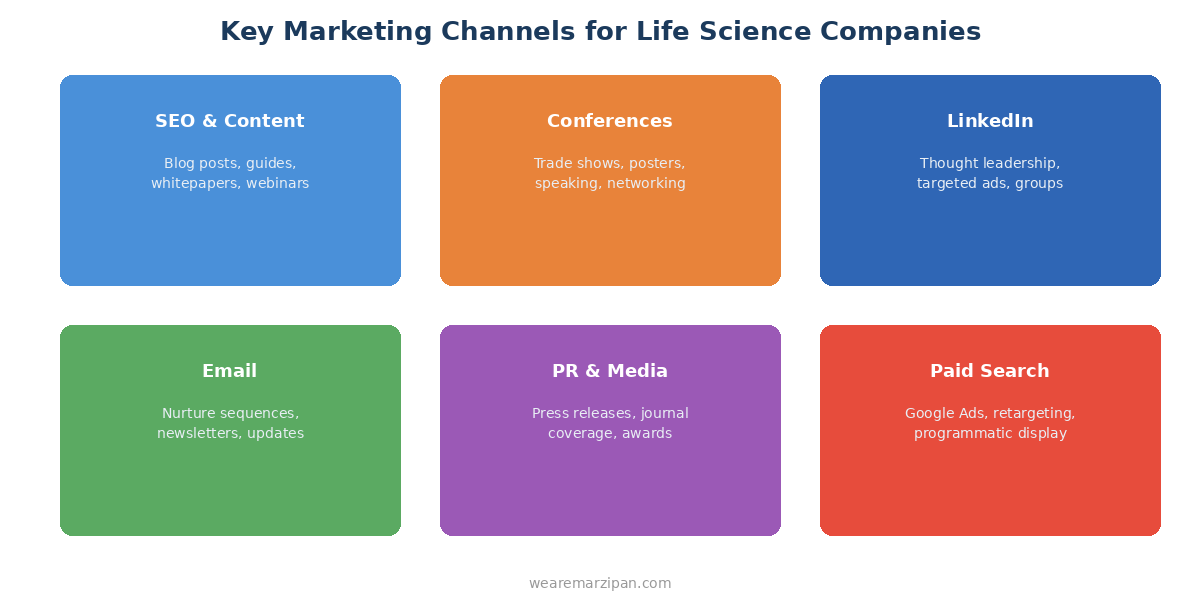
Not every channel works equally well in life sciences. Here are the ones that consistently drive results, and how to use them effectively.
SEO and Content Marketing
Search engine optimization is one of the highest-ROI channels in life science digital marketing. Scientists and buyers actively search for solutions, suppliers, and information online. If you're not showing up when they search for terms related to your products and services, you're invisible.
The key to life science content marketing is specificity. Don't write generic blog posts about "digital transformation" - write about the specific challenges your audience faces. A biotech company might publish a guide on scaling up manufacturing processes. A CRO might create content around clinical trial recruitment strategies. A lab equipment manufacturer might publish application notes showing their products in action.
The goal is to become the most helpful, authoritative resource in your niche. When you do that consistently, Google rewards you with rankings - and your audience rewards you with trust.
One often-overlooked aspect of life science SEO is the opportunity in long-tail keywords. While broad terms like "biotech" or "pharma" are extremely competitive, more specific queries -"GMP-compliant contract manufacturing for biologics" or "LIMS software for clinical laboratories" - have lower competition and higher intent. These searchers know exactly what they need and are much closer to a purchasing decision. Building a content library that targets these specific, high-intent terms can generate qualified pipeline even with modest traffic volumes.
LinkedIn is the dominant social platform for life science marketing. It's where decision-makers spend their time, where industry conversations happen, and where targeted advertising can reach very specific professional audiences. For B2B life science companies, LinkedIn strategy should include regular posting from company leadership (thought leadership), targeted ad campaigns reaching specific job titles and companies, and active engagement in relevant industry groups and conversations.
Industry Conferences and Events
Events like CPHI, BIO International, AAAS, and hundreds of niche conferences remain critical touchpoints. In-person interactions still drive a significant portion of new business in life sciences. The key is treating conferences as part of a broader marketing strategy - not as standalone events. That means pre-event outreach to targeted attendees, compelling booth design and collateral, speaking slots to demonstrate expertise, and post-event follow-up sequences that convert conversations into pipeline.
Email Marketing
Email is the backbone of B2B nurture in life sciences. With sales cycles stretching 6-18 months, you need a systematic way to stay in front of prospects without being pushy. Well-designed email automation programs that deliver genuine value - research summaries, industry updates, practical guides - keep your brand top of mind until the prospect is ready to buy.
Segmentation is critical here. A one-size-fits-all newsletter won't cut it when your audience includes R&D scientists, procurement managers, and C-suite executives. Build segments based on role, interest area, and buying stage, then tailor your content accordingly. The companies that do this well see open rates of 25-35% and click-through rates that significantly outperform industry averages.
PR and Media Relations
Coverage in industry publications, trade media, and scientific journals builds credibility at a level that paid advertising simply can't match. A strong PR strategy in life sciences involves press releases for product launches and milestones, contributed articles in trade publications, relationships with industry journalists and editors, and award submissions that validate your expertise. For the complete playbook, see our guide to life science public relations.
Paid Search and Paid Social
While organic channels should be the foundation, paid advertising accelerates results. Google Ads targeting high-intent keywords (e.g., "HPLC column supplier" or "contract manufacturing pharma") can capture demand at the moment of need. LinkedIn Ads allow precise targeting by job title, company, seniority, and industry. The cost-per-click tends to be higher in life sciences, but so does the deal value - making the unit economics work well for companies with average deal sizes above $50K. Our guide to life science advertising covers paid media in depth, and for a channel-by-channel playbook on turning that demand into qualified pipeline, see our guide to life science lead generation.
What does all this cost?
Everything in one flat monthly fee, no add-ons or surprises. Get the full breakdown, agency comparisons, and the results behind the fee in our pricing guide.
Building a Life Science Content Strategy
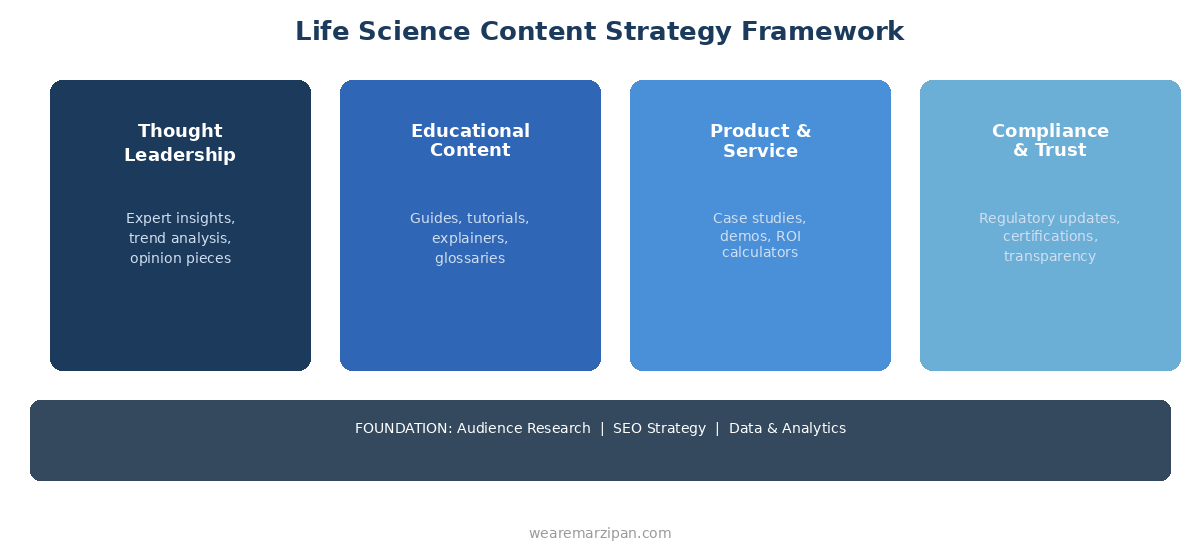
Content is the engine of modern life science marketing. But creating content without a strategy is just noise. Here's a framework for building a content engine that drives measurable results. For a deeper dive into content planning, distribution, and measurement, see our life science content marketing guide.
Pillar 1: Thought Leadership
Position your team as experts in your niche. Publish original perspectives on industry trends, share lessons from real-world projects, and weigh in on topics your audience cares about. The best thought leadership in life sciences comes from people who are genuinely close to the science - not from marketing teams writing in a vacuum.
Pillar 2: Educational Content
Guides, tutorials, glossaries, and how-to content serve two purposes: they attract organic search traffic (people actively searching for answers), and they build trust by demonstrating your knowledge. An in-depth guide on a topic like "how to choose a CDMO" or "regulatory pathways for medical devices" can drive traffic and leads for years.
Pillar 3: Product and Service Content
Case studies, product demonstrations, ROI calculators, and comparison pages help prospects evaluate your offering. This content sits at the middle and bottom of the funnel and is critical for converting interest into pipeline. The most effective case studies in life sciences include specific data points, named customers (where possible), and clear before-and-after narratives.
Pillar 4: Compliance and Trust
Regulatory updates, certification documentation, quality standards, and transparency around your processes build trust with risk-averse buyers. In an industry where a wrong decision can have serious consequences, content that demonstrates your commitment to compliance and quality can be a decisive differentiator.
Life Science Marketing Trends in 2026
The field is changing quickly. Here are the most significant trends shaping life science marketing right now:
AI-Assisted Marketing with Human Oversight
AI tools are accelerating everything from content creation to predictive analytics and audience segmentation. But in life sciences, where accuracy and credibility are non-negotiable, human oversight remains essential. The winning formula is using AI to handle research, drafts, and data analysis, while subject matter experts ensure everything that goes out the door is scientifically accurate and tonally appropriate.
Always-On Content Hubs
Healthcare professionals and scientists expect flexible, self-serve access to educational content. The shift is moving away from one-off webinars and gated PDFs toward always-on content libraries that blend live events, on-demand video, written guides, and microlearning modules. Companies building these hubs are seeing stronger engagement and longer time-on-site metrics.
Video and Short-Form Content
Video continues to grow as a format for explaining complex products and sharing customer stories. Short-form video (under 2 minutes) is particularly effective for LinkedIn and conference follow-ups. Explainer videos, product demos, and expert interviews are becoming standard components of a strong life science marketing stack.
Data-Driven Personalization
As life science companies invest in better CRM and marketing automation infrastructure, the ability to personalize outreach at scale is improving. Segmenting audiences by role, therapeutic area, company size, and buying stage - and tailoring content accordingly - dramatically improves engagement and conversion rates.
The Return of In-Person Events
After the pandemic-era shift to virtual events, in-person conferences and networking events have come back stronger than ever. Scientists and industry professionals are prioritizing face-to-face interactions, with renewed interest in smaller, focused events like lunch-and-learns, roundtables, and regional meetups alongside the major conferences. Smart life science marketers are treating events as part of an integrated strategy: using digital channels to drive pre-event awareness, maximizing in-person interactions during the event, and then following up digitally to convert those conversations into pipeline.
How does your brand perform in AI search?
Run a free AEO audit to see how visible your brand is in ChatGPT, Perplexity, and Google AI Overviews.
Working with a Life Science Marketing Agency
Not every company has the resources to build a full in-house marketing team - especially startups and scale-ups. A specialized life science marketing agency can fill that gap, bringing deep industry knowledge and a ready-made team of strategists, writers, designers, and digital specialists who already understand your market.
When evaluating agencies, look for these qualities:
- Scientific literacy. Can the team have an informed conversation about your products and your customers' challenges?
- Relevant case studies. Have they delivered results for companies in your sub-sector (biotech, pharma, medtech, etc.)?
- Full-funnel thinking. Do they approach marketing as a complete system - from SEO and content to sales enablement and analytics?
- Regulatory awareness. Do they understand the compliance requirements and build them into their process?
- Strategic focus. The best agencies won't just execute tactics - they'll push back, ask hard questions, and help you prioritize what matters most.
Not getting this from your current agency?
See how Marzipan runs your whole funnel with senior specialists, tied to pipeline and revenue, for one flat monthly fee.
Measuring What Matters: Life Science Marketing KPIs
Tracking the right metrics is essential to proving ROI and improving performance over time. Here are the KPIs that matter most in life science marketing:
| Funnel Stage | Key Metrics | Why It Matters |
|---|---|---|
| Awareness | Organic traffic, keyword rankings, social impressions, share of voice | Are you being found by the right people? |
| Consideration | Content engagement, email open/click rates, webinar attendance, time on site | Is your content earning attention and trust? |
| Decision | Marketing qualified leads (MQLs), demo requests, proposal requests, pipeline generated | Is marketing generating real opportunities? |
| Retention | Customer satisfaction (NPS), retention rate, expansion revenue, referral volume | Are customers staying and growing with you? |
The most important thing is connecting marketing activity to business outcomes. Vanity metrics like page views and social followers are fine to track, but they shouldn't be the headline. Focus on pipeline generated, revenue influenced, and customer acquisition cost.
Attribution can be tricky in life sciences because of the long sales cycle. A prospect might read a blog post in January, attend a webinar in April, visit your booth at a conference in June, and finally request a demo in September. Multi-touch attribution models that credit each touchpoint help you understand which channels are actually contributing to revenue - and which are just creating noise. Invest in the analytics infrastructure to track this, even if it takes time to set up.
Getting Started: Your First 90 Days
If you're just beginning to invest in life science marketing - or overhauling an existing program - here's a practical roadmap for the first 90 days:
- Audit your current state. Review your website, content library, SEO performance, and competitive positioning. Know where you stand before making changes.
- Define your ideal customer profile (ICP). Who are you trying to reach? What roles, industries, and company sizes? What problems are they trying to solve?
- Conduct keyword research. Identify the terms your audience is searching for and where your competitors are ranking. Tools like Ahrefs or SEMrush make this straightforward.
- Build your content foundation. Start with 3-5 cornerstone pieces that target your most important keywords and address your audience's biggest questions. Aim for thorough, authoritative content.
- Set up your analytics. Ensure Google Analytics, Google Search Console, and your CRM are properly configured to track the full journey from first touch to closed deal.
- Establish a publishing cadence. Consistency beats volume. Two high-quality pieces per month will outperform ten mediocre ones. Build the habit first, then scale.
- Measure and iterate. After 90 days, review what's working. Double down on the topics and channels driving results. Cut what isn't.
The Long Game
Life science marketing is a long game. The companies that commit to understanding their audience, creating genuinely useful content, and building systematic marketing programs are the ones that win, this quarter and year after year. The niche is yours for the taking if you're willing to do the work.
Whether you're building your marketing function in-house or partnering with a life science marketing agency, the principles in this guide provide a roadmap. Start with the fundamentals, stay consistent, and let the compounding effect of good marketing do its thing.
The life science sector is growing globally, with spending on biotech R&D, pharmaceutical development, and medical innovation all trending upward. Companies that invest in building a strong marketing foundation now will be the ones that capture that growth. The best time to start was yesterday. The second-best time is today.

Written by
Joe Chamberlain
Head of Digital Marketing
Joe has over a decade of experience delivering high-impact digital strategies for B2B and B2C brands. He's built more than 200 websites and led countless SEO and performance marketing initiatives - each one focused on driving measurable ROI and sustainable growth.
More articles by Joe