
Choosing a marketing agency is a critical investment for life science companies. The right agency can drive growth, strengthen your brand, and deliver results, while the wrong choice risks wasted budget and missed opportunities.
Knowing what to look for, and what to avoid, is the hard part. This guide outlines the essential criteria for evaluating a life science marketing agency, key questions for your selection process, and warning signs to notice. These principles hold up for a biotech startup seeking its first partner and for an established pharmaceutical company considering a switch, and they will help you make a confident, informed decision.
Why You Need a Specialist, Not a Generalist
Life science companies face unique constraints that most B2B agencies do not encounter. Regulatory bodies such as the FDA and EMA impose strict marketing rules, and scientific audiences demand a level of rigor that generalist agencies often lack.
Generalist B2B agencies might produce polished creatives, but messaging that misses with a PhD-level audience or includes claims that won't pass regulatory review wastes your investment. Worse, non-compliant materials can cause legal and reputational risk.
Precision in language is critical in life sciences. For example, a "cure" eliminates a disease, while a "treatment" manages symptoms. Claims of "superior efficacy" require published scientific evidence. Unsupported claims can prompt regulatory action. An agency that understands these subtleties will reduce revisions and protect your reputation.
Specialist life science agencies bring domain expertise that drives results. They convert complex science into effective marketing, distinguish between diagnostics and therapeutics, and manage compliance workflows. For additional sector challenges, see our complete guide to life science marketing.
The 6 Key Criteria for Evaluating a Life Science Agency
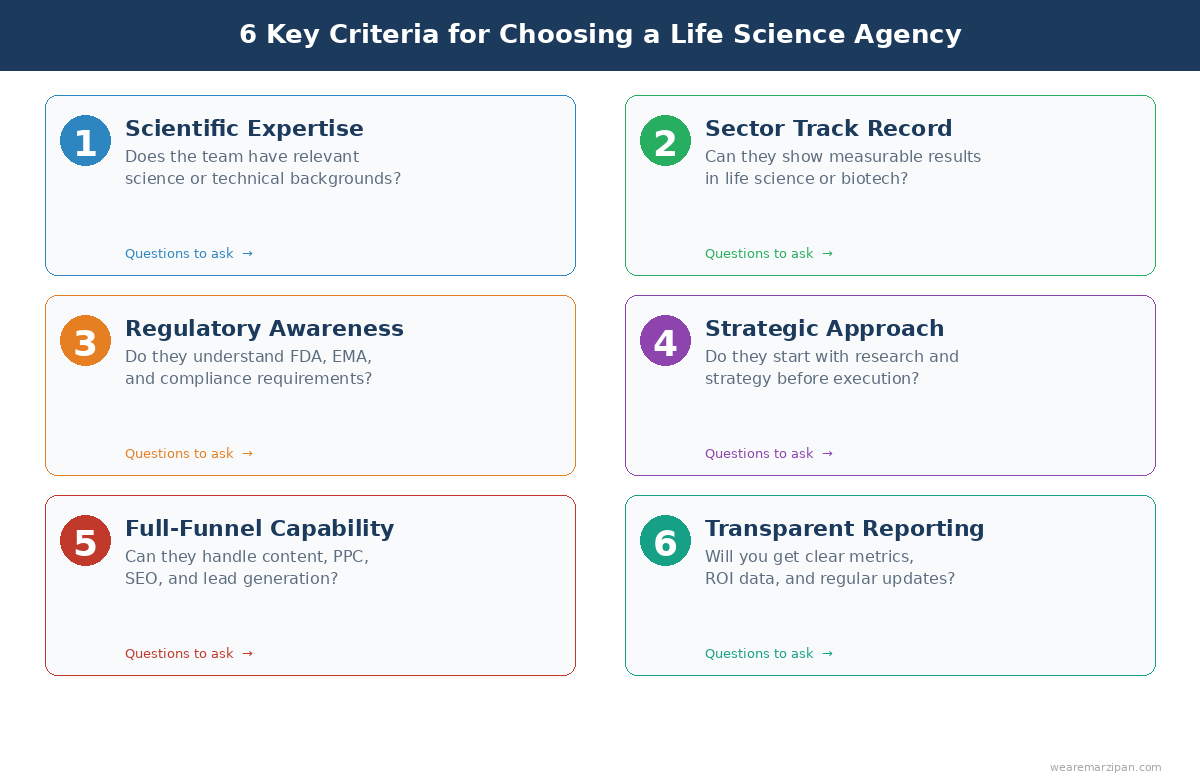
1. Scientific Expertise on the Team
First, assess whether the agency includes team members with genuine scientific understanding. While not everyone needs a PhD, the team should have individuals with relevant scientific or technical backgrounds who can credibly engage with your subject matter.
For example, at Marzipan, our founding team combines expertise in science, IT, and marketing, providing a cross-functional perspective that covers technical and commercial strategy. Our 20 years in life science marketing and 50 years in broader marketing ensure your content is accurate and effective.
Questions to ask:
- What scientific or technical backgrounds do your team members have?
- Who will be reviewing our content for scientific accuracy?
- Can you guide me through how you handle technically complex briefs?
2. A Proven Track Record in Your Sub-Sector
Life sciences encompass diverse sectors. An agency with pharmaceutical marketing experience may not suit a biotech startup, and vice versa. Seek evidence of results in your specific area. According to the Content Marketing Institute's B2B research, 72% of top-performing marketers attribute their success to a solid understanding of their audience. In life sciences, this understanding comes from direct experience.
Request case studies with measurable outcomes. General claims about "increasing brand awareness" are insufficient. Look for specific metrics such as pipeline generated, cost per lead, conversion rates, and revenue impact.
“We partnered with SciLeads to rebuild their website, restructure content strategy and lead generation, resulting in $1.4M in pipeline growth and $280K in bookings within 12 months.”
Marzipan Case Study
Read the full SciLeads case study.
Questions to ask:
- Can you share case studies from companies in our specific sub-sector?
- What were the definable outcomes of your last three life science campaigns?
- How do you define and measure success for your clients?
3. Regulatory Awareness and Compliance Understanding
A life science agency must understand marketing rules. In pharmaceuticals, this includes FDA promotional policies, MLR review (when legal and medical experts review content), and the difference between advertising and educational materials. In biotech and medtech, rules differ depending on your product and target markets.
An agency does not need to be a regulatory consultancy, but it should have enough knowledge to avoid producing content that would be flagged during compliance review. This saves significant time and rework. For more information on rules in pharmaceutical marketing, see our pharmaceutical marketing strategy guide.
Questions to ask:
- How do you handle content that requires MLR or regulatory review?
- Have you worked with companies that sell FDA-regulated or CE-marked products?
- Can you give an example of how you adapted a campaign for compliance?
4. Strategy-First, Not Tactics-First
Be wary of agencies that propose deliverables without first understanding your market position, competition, and business objectives. A credible agency will require a research and discovery phase before recommending tactics.
This phase should include a marketing performance audit, competitor analysis, audience research, and clear goals and KPIs. Without this foundation, even well-executed campaigns may target the wrong audience or keywords. For example, an effective life science SEO strategy begins with understanding what your buyers are actually searching for.
Questions to ask:
- What does your onboarding and discovery process look like?
- How do you conduct competitor and audience research?
- How long before we should expect to see a strategic plan?
5. Full-Funnel Capability
Life science marketing is not a single-channel discipline; it requires a multi-channel approach. An effective agency should support your goals across the entire funnel, from awareness (content marketing, SEO, thought leadership) to consideration (email nurture, webinars, case studies) and decision (PPC, retargeting, sales enablement). If earned media is on your list, our life science PR agency evaluation guide covers what to test before you sign.
Successful life science marketing programs align all channels under a unified strategy. For example, coordinating SEO content with paid search improves results, as keyword research benefits both, and organic content can enhance PPC Quality Scores. For more on integrating content and SEO, see our biotech marketing guide.
“For SciLeads, we delivered a website rebuild, content strategy, and lead generation, resulting in $1.4M in pipeline growth and $280K in bookings within 12 months.”
Marzipan Case Study
Read the full SciLeads case study.
Questions to ask:
- Which marketing channels do you have in-house expertise for, and which do you hire outside specialists to handle?
- How do you approach lead generation for long sales cycles?
- Can you show examples of full-funnel campaigns you have managed?
How does your brand perform in AI search?
Run a free AEO audit to see how visible your brand is in ChatGPT, Perplexity, and Google AI Overviews.
6. Transparent Reporting and Accountability
Finally, assess how the agency reports performance. Vanity metrics such as impressions and social media followers offer limited value in life sciences, where the buyer journey is complex. Choose an agency that reports on metrics tied to business outcomes, such as marketing qualified leads, pipeline contribution, cost per acquisition, and return on investment.
Request a sample report during the selection process. According to HubSpot's State of Marketing report, only 35% of marketers can accurately measure campaign ROI. An agency that delivers clear, data-driven reporting from the start is highly valuable.
Questions to ask:
- What does your standard reporting cadence and format look like?
- Which KPIs do you track, and how do you attribute results to marketing activity?
- Can I see a sample report from a current or past client (anonymized)?
Red Flags to Watch For
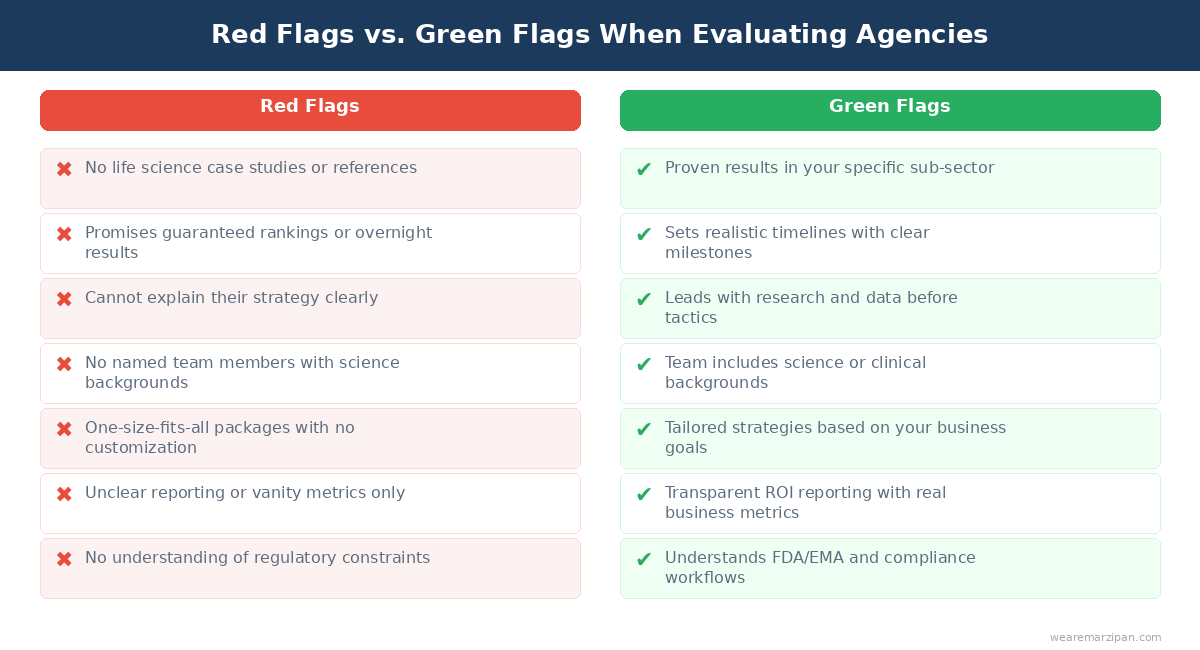
During evaluation, watch for the following warning signs:
- Guaranteed rankings or results: No legitimate agency can guarantee specific Google rankings or lead volumes. SEO and marketing are inherently influenced by factors outside any agency's control, including algorithm changes, competitor activity, and market conditions.
- No discovery phase: Agencies that propose tactics before understanding your business are offering a template, not a tailored strategy.
- Reluctance to share references: A reputable agency will readily connect you with current or recent clients. Inability to provide life science references is a major concern.
- Opaque pricing: You should know exactly what you are paying for. Agencies that bundle services without itemizing deliverables and hours make it difficult to assess value.
- Over-reliance on jargon: Be cautious of agencies that use excessive buzzwords but cannot clearly explain how their approach will achieve your business goals.
- No clear point of contact: You should know who leads your account and whom to contact. Agencies without a dedicated lead often deliver inconsistent work and poor communication.
Conversely, positive signs include agencies that ask challenging questions, push back on unrealistic timelines, and are transparent about their capabilities. An agency that advises against ineffective tactics for your sector demonstrates the candor needed for a strong partnership.
A Practical Selection Process
Selecting an agency does not require a lengthy procurement process, but a structured approach leads to better decisions:
- Step 1: Define your needs. Before contacting agencies, clarify your requirements. Do you need a full marketing overhaul or a specific capability such as SEO or PPC? What is your budget? What does success look like in 6 and 12 months?
- Step 2: Create a shortlist of 3-5 agencies. Prioritize those with demonstrated life science expertise. Review their case studies, blog content, and team bios. Industry directories such as Clutch.co can help refine your list.
- Step 3: Request and compare proposals. A strong proposal should address your specific challenges rather than offer generic services. Note how well the agency listened during your briefing.
- Step 4: Check references. Speak with at least two current or recent clients. Ask about communication, responsiveness, results, and whether they would hire the agency again.
- Step 5: Start with a defined project. If uncertain, begin with a smaller engagement, such as a strategy audit or single campaign, before committing to a long-term retainer. This approach allows you to assess fit and performance with minimal risk.
What to Expect in Terms of Investment
Life science marketing agency fees vary widely depending on scope, geography, and the seniority of the team assigned to your account. As a general benchmark, the Association of National Advertisers reports that most B2B companies allocate between 2% and 5% of revenue to marketing. For life science companies in growth mode, that figure often skews higher.
Monthly retainers for specialist life science agencies typically range from $5,000 to $25,000, depending on service scope. Project-based work, such as website redesigns or SEO audits, may range from $10,000 to $100,000 or more. Be cautious of agencies that significantly undercut market rates, as they may lack the expertise or senior resources required for this sector.
The most important metric is not cost but return on investment. An agency that charges $15,000 per month but generates $1.4M in pipeline growth (as in the SciLeads case above) represents a vastly better investment than a cheaper alternative that delivers vague awareness metrics.
Consider the hidden costs of hiring a generalist agency. If their team lacks scientific expertise, your internal experts will spend more time reviewing and correcting content. This resource drain is often overlooked in cost comparisons but can be significant, especially for smaller companies with limited technical staff.
What does all this cost?
Everything in one flat monthly fee, no add-ons or surprises. Get the full breakdown, agency comparisons, and the results behind the fee in our pricing guide.
In-House Team, Agency, or Both?
Many life science companies consider whether to build an in-house marketing team or hire an agency. In practice, a hybrid model is often most effective: a lean internal team manages brand strategy and product knowledge, while an external agency provides specialist skills, extra capacity, and an outside perspective.
This model offers flexibility. An agency can scale its efforts based on your product launches, conference schedules, or funding milestones, without the fixed costs of full-time hires. The internal team ensures continuity and deep institutional knowledge.
If you pursue this model, choose an agency willing to work as an extension of your team. The best partnerships involve agencies that integrate with your organization, attend internal meetings, understand your product roadmap, and proactively suggest opportunities.
Not getting this from your current agency?
See how Marzipan runs your whole funnel with senior specialists, tied to pipeline and revenue, for one flat monthly fee.
Evaluating the Relationship After You Start
Selecting an agency is just the start. The first 90 days are critical for determining if the partnership will deliver long-term value. During this period, monitor several key indicators.
First, assess communication quality. Is the agency proactive with updates, or do you need to request progress reports? A strong agency will set regular check-ins and reporting from the start, such as weekly status calls and monthly reviews.
Second, evaluate strategic scope. Does the agency offer ideas and recommendations, or only execute assigned tasks? The best agencies act as strategic advisors, identifying new opportunities and challenging assumptions when supported by data.
Third, review early performance indicators. While ROI in life science marketing may take 6 to 12 months, you should see progress within the first quarter, such as execution of an SEO content calendar, data-driven ad optimizations, and a clear tracking framework.
Making Your Decision
The ideal life science marketing agency combines scientific expertise with proven marketing execution. They should demonstrate measurable results in your sector, communicate transparently, and approach your marketing as a strategic investment.
If you are considering your options and would like to discuss Marzipan's approach to life science marketing, please contact us. We are happy to discuss your goals, even if we are not the right fit.
Related Reading

Written by
Joe Chamberlain
Head of Digital Marketing
Joe has over a decade of experience delivering high-impact digital strategies for B2B and B2C brands. He's built more than 200 websites and led countless SEO and performance marketing initiatives - each one focused on driving measurable ROI and sustainable growth.
More articles by Joe