
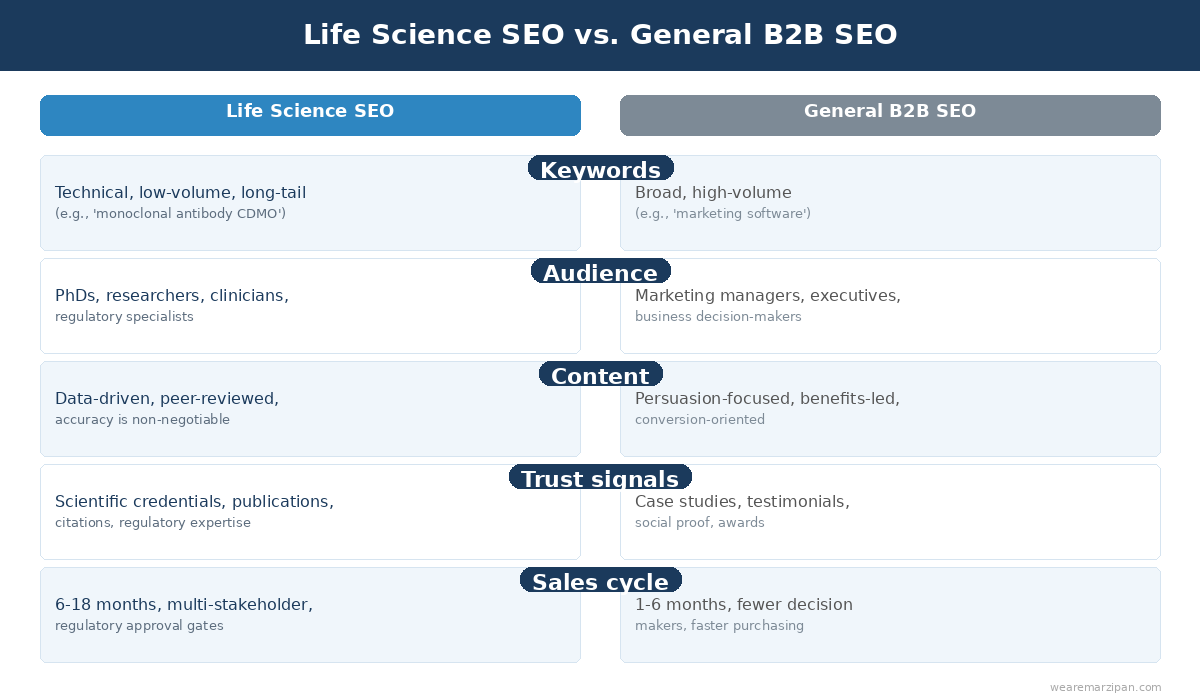
Life science companies face a unique challenge with search engine optimization. Unlike general B2B businesses, your audience is composed of researchers, clinicians, and procurement specialists who search using highly technical terminology. A search for "monoclonal antibody CDMO" or "GMP-grade peptide synthesis" looks nothing like a typical B2B keyword, and that is exactly why standard SEO playbooks often fall short in this industry.
This guide covers everything you need to know about life science SEO, from keyword research for scientific audiences to technical optimization, content strategy, and link building. If you are marketing biotech services, pharmaceutical products, or laboratory equipment, these strategies will help you build sustainable organic visibility in one of the most specialized sectors online. And as buyers increasingly ask AI assistants for shortlists, that visibility now extends to being cited in AI answers, which we cover in our guide to AI in pharma marketing.
Why Life Science SEO Is Different
Before diving into tactics, it is worth understanding why life science SEO requires a specialized approach. According to Google's Search Quality Evaluator Guidelines, life science and healthcare content falls under "Your Money or Your Life" (YMYL) topics. This means Google applies a higher standard of scrutiny to this content, placing particular emphasis on E-E-A-T: Experience, Expertise, Authoritativeness, and Trustworthiness.
For life science companies, this has several practical implications. Your content must demonstrate genuine scientific expertise rather than surface-level summaries. Author credentials matter significantly, so featuring named scientists, PhDs, or industry specialists as authors (with proper author bios) can directly impact how Google evaluates your pages.
The keywords themselves are also fundamentally different. Life science search terms tend to be low-volume but high-intent. A keyword like "biotech marketing" might only get 300 searches per month, but each of those searchers is far more likely to become a qualified lead than someone searching for "marketing tips" at 50,000 monthly searches. This means that even small gains in organic rankings can translate into meaningful business outcomes.
Keyword Research for Scientific Audiences
Effective keyword research in life sciences goes beyond plugging seed terms into a keyword tool. Here is a framework for identifying the terms your target audience actually uses.
Map Your Buyer Journey to Search Intent
Life science buying cycles are long, often spanning 6 to 18 months, with multiple stakeholders involved at each stage. Your keyword strategy should reflect this:
- Awareness stage: "What is [technology/approach]?" queries. Example: "what is CRISPR gene editing" or "mRNA vs protein subunit vaccines."
- Consideration stage: "How to" and comparison queries. Example: "how to choose a CDMO" or "in-house vs outsourced bioanalytical testing."
- Decision stage: "Best," "top," agency, or vendor-specific queries. Example: "best biotech marketing agency" or "GMP manufacturing services."
Mine Scientific Terminology
Your audience uses precise technical language. Use PubMed and Google Scholar to identify how researchers describe problems in published literature. The terminology they use in papers is often the same terminology they type into Google. Look at paper titles, abstracts, and MeSH (Medical Subject Headings) terms for keyword inspiration.
Tools like Ahrefs and Semrush can help quantify search volume for these terms, but do not dismiss keywords with very low reported volumes. In life sciences, a keyword with 50 monthly searches could represent dozens of highly qualified prospects.
Analyze Competitor Keywords
Identify which keywords your direct competitors rank for using tools like Ahrefs' Site Explorer or Semrush's Organic Research. Focus on finding gaps: keywords your competitors rank for that you do not. Pay particular attention to keywords where competitors rank in positions 5 through 20, as these represent realistic opportunities to outrank them with better content. For a broader view of how to approach competitor analysis in this space, see our life science marketing guide.
It is also worth examining which content formats your competitors are using for their highest-ranking pages. If the top results for your target keyword are all 3,000-word guides, you will likely need to produce something of similar depth. If they are short glossary-style pages, an in-depth guide could leapfrog them. Understanding what already ranks for each keyword cluster helps you allocate resources effectively.
Do Not Ignore Long-Tail Keywords
In life sciences, long-tail keywords are often more valuable than their head-term counterparts. A keyword like "cell line authentication services for pharmaceutical companies" may only receive 20 searches per month, but the intent behind that search is extremely specific and commercial. These searchers are typically further along in the buying process and more likely to convert.
Build a dedicated spreadsheet of long-tail keywords organized by product line or service area. Over time, creating content targeting these specific queries accumulates into a substantial organic traffic stream with excellent conversion rates.
Technical SEO for Life Science Websites
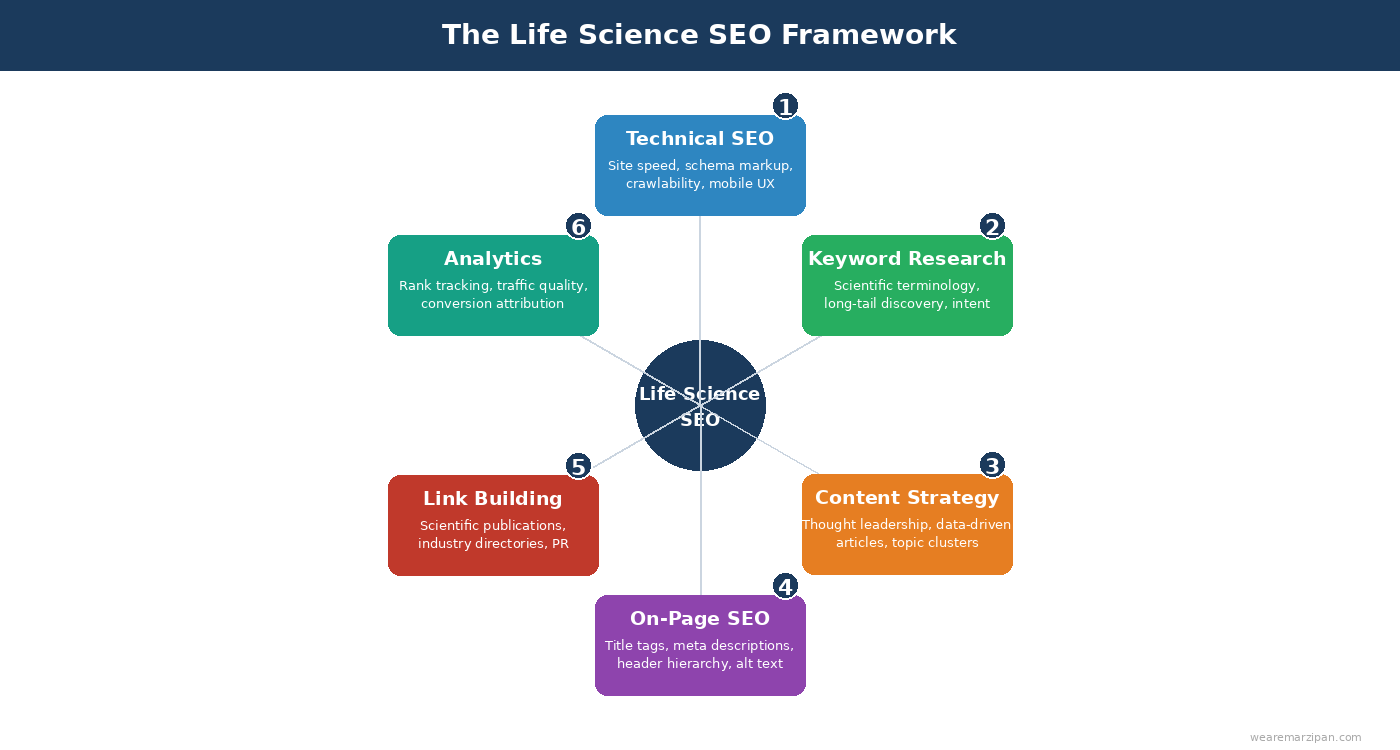
Technical SEO ensures that search engines can efficiently crawl, index, and rank your pages. For life science websites, which often feature complex product catalogs, resource libraries, and gated content, getting the technical foundations right is especially important. It is easiest when SEO is built into the site from the start, which is exactly how we approach life science web design.
Site Speed and Core Web Vitals
Google's Core Web Vitals measure loading performance, interactivity, and visual stability. Life science websites frequently underperform here due to large PDF downloads, high-resolution microscopy images, and embedded video content. Prioritize image compression (use WebP format where possible), lazy loading for below-the-fold content, and a fast, reliable hosting infrastructure.
Schema Markup
Structured data helps search engines understand your content contextually. For life science companies, relevant schema types include Organization (for your company), Article or ScholarlyArticle (for blog posts and whitepapers), Product (for services or equipment), and FAQPage (for technical FAQs). Implementing schema correctly can earn rich snippets in search results, increasing click-through rates.
Crawlability and Indexation
Audit your robots.txt and XML sitemap regularly. Common issues on life science sites include accidentally blocking resource library pages behind JavaScript rendering, creating orphaned pages in complex product hierarchies, and generating duplicate content through parameterized URLs (common with catalog filters). Use Google Search Console to monitor index coverage and address crawl errors promptly.
Mobile Optimization
Google uses mobile-first indexing, meaning it primarily crawls the mobile version of your site. While scientists and researchers may browse primarily on desktop during working hours, procurement professionals and decision-makers increasingly access content on mobile devices during commutes and conferences. Ensure your site is fully responsive, forms are easy to complete on smaller screens, and PDF resources are either mobile-friendly or supplemented by web-based versions. Test your pages using Google's PageSpeed Insights to identify mobile-specific issues.
Content Strategy That Builds Topical Authority
In life sciences, content is the engine that drives organic growth. But it is not enough to publish individual blog posts. You need a structured approach that builds topical authority, and that starts with understanding your target audiences and what they are actually searching for.
The Topic Cluster Model
Organize your content around pillar pages and supporting cluster content. A pillar page provides a complete overview of a broad topic (such as our life science marketing guide), while cluster pages go deep on specific subtopics (like our guides to biotech marketing and pharmaceutical marketing strategy). Internal links between these pages signal to Google that your site covers the topic thoroughly.
Content Types That Perform in Life Sciences
Not all content formats perform equally well in this sector. The formats that consistently drive organic traffic for life science companies include:
- In-depth guides and frameworks: Long-form content (2,000+ words) that covers a technical topic in full. These tend to rank well because they satisfy search intent thoroughly.
- Data-driven articles: Content backed by original data, industry statistics, or proprietary research. Life science audiences expect evidence.
- Technical comparisons: "X vs Y" content that helps researchers and procurement professionals evaluate options. These capture high-intent search traffic.
- Glossaries and resource pages: Definitions of technical terms can capture long-tail search traffic and serve as internal linking hubs.
Content Quality Standards
Every piece of content should be reviewed for scientific accuracy before publication. This does not mean you need full peer review, but having a subject matter expert sign off on technical claims is essential. Google's emphasis on E-E-A-T means that demonstrably accurate, expert-authored content will consistently outperform generic marketing copy. The National Institutes of Health and FDA are excellent sources to reference when making scientific or regulatory claims, and linking to them demonstrates the kind of authoritative sourcing that Google values.
Gated Content and SEO: Finding the Balance
Life science marketers often gate their best content behind lead capture forms: whitepapers, webinar recordings, and technical reports. While gating content is a valid lead generation tactic, it creates a tension with SEO. Search engines cannot index gated content, which means all the keywords and topical relevance contained in a 30-page whitepaper remain invisible to Google.
The most effective approach is to create ungated summary pages or blog posts that cover the key findings from your gated content. These pages can rank for relevant keywords and include a call to action to download the full resource. This way, you capture both organic traffic and leads. For example, publish a 2,000-word blog post summarizing your whitepaper's key insights, then offer the full report as a PDF download at the end.
How does your brand perform in AI search?
Run a free AEO audit to see how visible your brand is in ChatGPT, Perplexity, and Google AI Overviews.
On-Page SEO Best Practices
On-page SEO is where your keyword research meets your content. Here are the key elements to optimize for every page:
- Title tags: Keep under 60 characters. Include your primary keyword near the beginning. Make it compelling enough to earn clicks from the SERP.
- Meta descriptions: Under 160 characters. Include the primary keyword and a clear reason to click. While meta descriptions are not a direct ranking factor, they significantly influence click-through rate.
- Header hierarchy (H1 through H4): Use a logical structure with one H1 per page. Include secondary keywords in H2s and H3s where natural.
- Image alt text: Describe every image with relevant keywords where appropriate. This is especially important for diagrams, charts, and scientific figures that are common in life science content.
- Internal linking: Every piece of content should link to at least 2 to 3 other relevant pages on your site. This distributes link equity and helps search engines discover and understand the relationship between your pages.
- URL structure: Keep URLs short, descriptive, and keyword-rich. Use hyphens to separate words. Avoid parameter-heavy URLs like "/page?id=12345".
Link Building for Life Science Companies
Backlinks remain one of the strongest ranking factors in Google's algorithm. For life science companies, the good news is that your industry naturally produces the kind of authoritative, citable content that earns links. The challenge is being strategic about it.
Use Industry Directories
Start with the foundational links that every life science company should have. List your company on relevant directories such as Clutch.co (for agencies), Crunchbase (for company profiles), and industry-specific directories like News-Medical.net supplier listings. These are typically high-authority domains (DR 85+) and provide immediate credibility.
Publish Original Research
Content that contains original data, survey results, or novel analysis naturally attracts backlinks. Consider publishing annual industry reports, benchmark studies, or data analyses relevant to your niche. When other publications reference your data, they link back to the source. This is one of the most sustainable link-building strategies in the life science space.
Guest Contributions and Thought Leadership
Contributing articles to industry publications and appearing on podcasts are proven strategies. Platforms like Medium and industry newsletters on Substack offer opportunities to reach new audiences while earning backlinks. Focus on providing genuine value rather than promotional content. The "give first" approach builds relationships that lead to organic link opportunities over time.
PR and Press Releases
Distribute press releases through services like PR Newswire for significant company announcements: new partnerships, product launches, funding rounds, or major hires. While these links are often nofollow, they generate brand visibility and can lead to follow-up coverage from journalists and industry publications, which often do provide dofollow links.
Conference and Event Participation
Life science conferences provide excellent link-building opportunities. When you sponsor, exhibit at, or speak at events like CPhI, ELRIG, or the Festival of Genomics, the event website typically links to your company page. Scientific societies like the Royal Society of Chemistry and the American Chemical Society host events with high-authority .org domains. Even virtual conferences and webinars hosted on platforms like ON24 or BrightTALK can generate backlinks from their speaker and sponsor pages.
Not getting this from your current agency?
See how Marzipan runs your whole funnel with senior specialists, tied to pipeline and revenue, for one flat monthly fee.
Measuring SEO Success in Life Sciences
SEO is a long-term investment, and measuring progress correctly is essential to maintaining stakeholder buy-in. Here are the metrics that matter most:
- Organic keyword rankings: Track your target keywords weekly. Focus on movement trends rather than day-to-day fluctuations.
- Organic traffic: Monitor monthly organic sessions in Google Analytics. Segment by landing page to identify which content is driving growth.
- Click-through rate (CTR): Use Google Search Console to identify pages with high impressions but low CTR. These are opportunities to improve title tags and meta descriptions.
- Backlink profile growth: Track the number and quality of referring domains over time. Quality matters more than quantity.
- Conversions from organic: Ultimately, SEO should drive business outcomes. Track form submissions, demo requests, or contact inquiries attributed to organic search.
Expect to see meaningful results within 3 to 6 months for low-competition keywords, and 6 to 12 months for more competitive terms. Life science SEO rewards patience and consistency.
One metric that is often overlooked is branded search volume: how many people are searching for your company name directly. Growth in branded search is a strong indicator that your overall marketing and SEO efforts are building awareness. You can track this in Google Search Console by filtering for queries containing your brand name.
Common Life Science SEO Mistakes to Avoid
Even companies with strong technical expertise make avoidable SEO errors. Here are the most common pitfalls:
- Neglecting existing content: Companies often focus exclusively on creating new content while ignoring pages that already rank. Updating and expanding existing pages is frequently the fastest way to improve rankings. Refresh outdated statistics, add new sections, and improve internal linking on your top-performing pages at least every 6 to 12 months.
- Targeting keywords that are too competitive: A new or small life science company attempting to rank for "pharmaceutical marketing" before establishing domain authority is unlikely to see results quickly. Start with lower-difficulty keywords and work your way up as your site gains authority.
- Ignoring search intent: If someone searches for "CDMO selection criteria," they want a practical evaluation framework, not a sales pitch for your CDMO services. Matching your content to what the searcher actually wants is fundamental to ranking well.
- Treating SEO as a one-time project: SEO is an ongoing process. Algorithms change, competitors publish new content, and your audience's search behavior evolves. Commit to a regular cadence of content creation, technical audits, and performance analysis.
Getting Started
Life science SEO is not about chasing high-volume vanity keywords. It is about building a systematic content and technical foundation that positions your company as the definitive resource in your niche. Start with the fundamentals: clean up your technical SEO, build a keyword map around your buyer journey, and publish expert-authored content consistently.
If you are looking for a partner to help you build and execute a life science SEO strategy, get in touch with Marzipan. We specialize in helping life science and biotech companies grow their organic visibility through data-driven content and SEO.
Related Reading

Written by
Joe Chamberlain
Head of Digital Marketing
Joe has over a decade of experience delivering high-impact digital strategies for B2B and B2C brands. He's built more than 200 websites and led countless SEO and performance marketing initiatives - each one focused on driving measurable ROI and sustainable growth.
More articles by Joe